
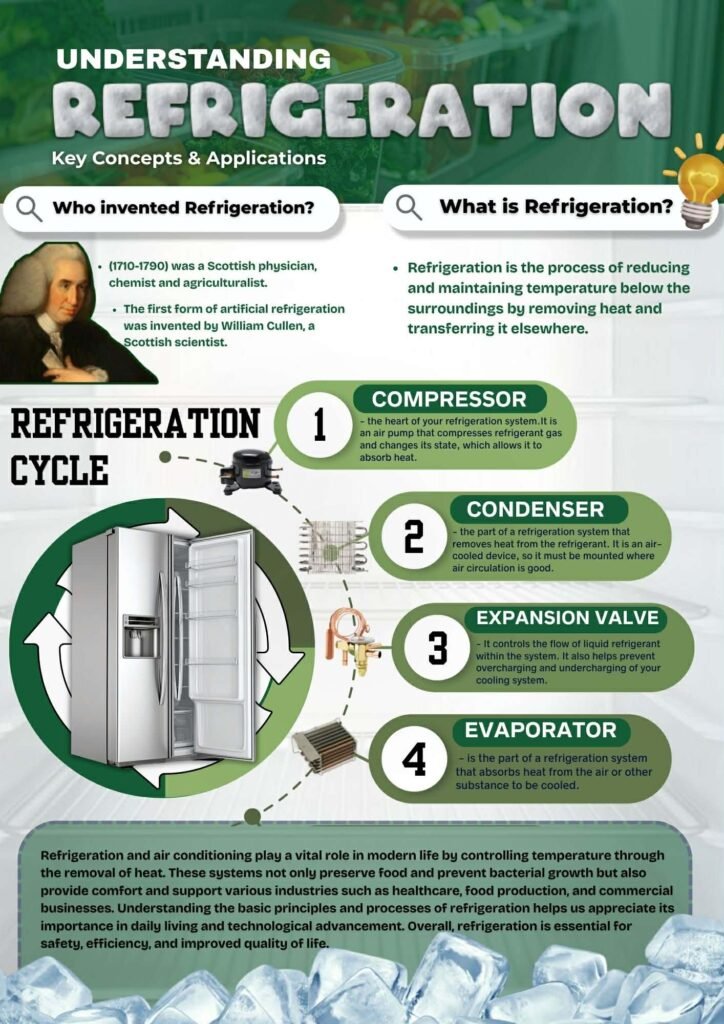
I created the infographic titled “REFRIGERATION” as a major academic project for a thermodynamics physics unit or a basic systems technology course. The assignment required us to select a common household appliance or everyday technology and break down the underlying scientific principles and mechanical processes that make it work. I decided to focus on refrigeration because it is a technology we interact with daily but rarely think about from a mechanical or historical engineering perspective.
My primary goal with this design was to demystify the core mechanics of the cooling process by transforming rigid engineering diagrams into an approachable, user-friendly guide. I began by framing the top section around two fundamental introductory questions regarding the history and basic scientific definition of refrigeration. By establishing who invented it and what it actually does right at the start, I wanted to provide an accessible entry point for any student or reviewer looking at the graphic.
To clearly illustrate the actual physics at play, I designed a numbered, step-by-step breakdown of the four primary components: the Compressor, Condenser, Expansion Valve, and Evaporator. I arranged these steps sequentially alongside a circular arrow graphic wrapped around a realistic refrigerator model, creating a continuous loop that visually mirrors the thermodynamic cycle itself. This layout choice was intended to show my instructor that I didn’t just memorize the parts, but genuinely understood how the refrigerant moves through the system to absorb and transfer heat.
Ultimately, I wrapped up the infographic with a comprehensive closing statement at the bottom to highlight the real-world applications and societal importance of this technology, noting its vital role in food preservation, healthcare, and commercial industries. Through this project, I aimed to demonstrate to my professor my ability to synthesize technical engineering concepts into a clear, visually structured informational hierarchy. At the same time, it allowed me to practice balancing dense factual descriptions with a clean, cohesive green color scheme and appropriate vector elements.